

Quick answer: When you choose a clothing manufacturer, look past the price list and check ten capabilities: fast, well-run sampling (8 to 10 days is a good benchmark); decoration done in-house rather than sent out; full private label services such as woven neck labels, care labels, hang tags and packaging; DDP (Delivered Duty Paid) shipping to your country; a low MOQ with mixed sizes; a written quality control process; real fabric knowledge; clear communication; experience in your product category; and fair payment and after-sales terms. A factory that is strong on all ten will usually cost you less overall than a cheaper one that fails on two or three.
Most brands compare manufacturers on unit price first. It’s understandable, but it’s also the reason so many first orders go wrong. The real cost of a manufacturer shows up later: a sample that takes five weeks, a print job sent to another workshop that comes back faded, a customs bill nobody warned you about, or a box of hoodies with someone else’s label in them.
We have been making custom sportswear, teamwear and streetwear in Sialkot, Pakistan, since 2010, for clubs and brands in the UK, Europe, the USA, Australia and New Zealand. This checklist is what we would look for if we were the ones placing the order. If you’re still at the stage of finding factories to contact, start with our guide on how to find a clothing manufacturer. If you already have a shortlist, keep reading, and use the scorecard at the end to compare them side by side.

The 10-Point Manufacturer Checklist at a Glance
| # | What to check | What good looks like | Warning sign |
|---|---|---|---|
| 1 | Sampling and development | Sample in 8 to 10 days, written feedback rounds, help with tech packs | No sample offered, or “sample after deposit for bulk” |
| 2 | In-house decoration | Sublimation, embroidery and printing done on site | Every decoration job sent to a third party |
| 3 | Private label services | Woven neck labels, care labels, hang tags, polybags, packaging | “Labels are your responsibility” |
| 4 | Shipping and duties | DDP to your country, clear landed cost per piece | FOB only, with no help on customs |
| 5 | MOQ and size flexibility | Low MOQ per design, sizes can be mixed | High MOQ per colour, per size |
| 6 | Quality control | Written multi-stage QC, third-party inspection welcome | “We check everything”, with no detail |
| 7 | Fabric knowledge | Advice on GSM, blends and performance, swatches available | Can’t tell you the fabric weight |
| 8 | Communication | Quote within 24 to 48 hours, one contact person, everything confirmed in writing | Slow replies, vague answers, changes made by phone only |
| 9 | Category experience | Real photos and case studies of your product type | Stock photos and “we make everything” |
| 10 | Payment and after-sales | Clear terms, secure payment options, written fix for faults | 100% upfront in cash, no returns policy for faults |
1. Sampling and Development: Speed With Substance
The sample is where you find out whether a manufacturer can actually make your product. A good factory can turn a clear tech pack into a first sample in about 8 to 10 days. If you’re quoted four to six weeks for a simple jersey or hoodie, it usually means the factory is overbooked or relies on outside workshops for key steps.
Speed alone isn’t the goal, though. A fast sample that ignores your measurements wastes more time than a slightly slower one done properly. Look for these signs of a well-run development process:
- They help with your tech pack. If you only have a sketch or a reference garment, a good manufacturer will help you turn it into a proper spec. Our tech pack guide and free tech pack template show what a factory needs.
- They measure the sample against your size chart and tell you where it’s off, rather than waiting for you to find it.
- They agree feedback in writing. Fit, fabric, colour and decoration comments should be logged, so the bulk order matches the approved sample.
- They are clear about sample costs. Many factories charge for samples because they involve pattern-making, cutting and printing for a single piece. Some credit part or all of the sample fee against your bulk order. Ask about this upfront so there are no surprises. At Pexton, 50% of your sample fee is credited against your bulk order.
For a step-by-step look at what happens during development, see how clothing samples are developed, and use our sample approval checklist when the sample arrives.
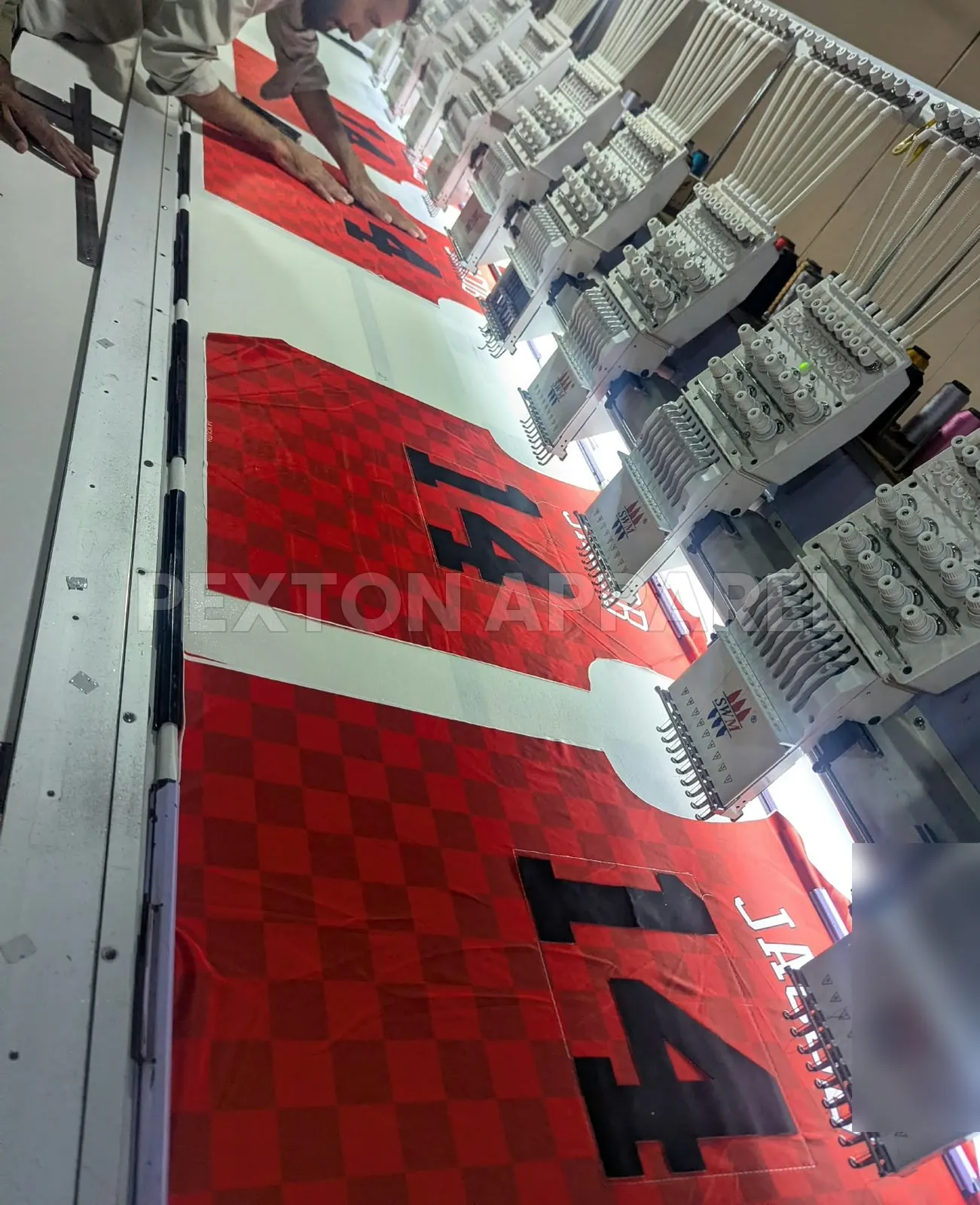
2. In-House Decoration: Fewer Hand-Offs, Fewer Problems
Decoration is where many orders go wrong. When a manufacturer cuts and sews your garments but sends them to another workshop for printing or embroidery, three things happen: lead times stretch while pieces travel back and forth, quality control gets split between two businesses, and when something goes wrong, each one blames the other.
A factory with its own decoration set-up keeps everything under one roof. Ask specifically which of these are done on site:
- Sublimation printing: essential for full-colour team kits, cycling jerseys, rash guards and leggings. The ink becomes part of the polyester, so it won’t crack or peel. Read how sublimation printing works and our sublimated sportswear guide.
- Embroidery: best for crests, logos on hoodies, caps and tracksuits. Ask how many heads their machines have, as this affects how quickly they can run bulk.
- Screen printing: the most cost-effective option for bold, simple artwork on cotton tees and hoodies in larger runs.
- Heat transfer and DTF: useful for names and numbers, small logos and detailed artwork on dark fabrics.
Not sure which method suits your design? Our comparison of embroidery vs screen printing vs sublimation explains the cost, durability and look of each.
3. Private Label Services: Your Brand, Not Theirs
If you’re building a brand, the garment is only half the product. Labels, tags and packaging are what make it feel like yours. A proper private label manufacturer should offer:
- Custom woven neck labels or printed heat-transfer neck labels for a tagless feel. See woven vs printed clothing labels.
- Care and composition labels that meet the rules in the countries you sell in. Our clothing label requirements guide covers the UK, EU, USA, Australia and New Zealand.
- Branded hang tags, swing tickets and barcode stickers if you sell through retailers.
- Custom polybags, mailers and boxes, ideally packed and ready to ship straight to your customers.
One more thing to check: make sure the factory doesn’t add its own branding anywhere on your garments or packaging. You can learn more about how this works on our private label manufacturing page, or see everything a new brand needs in our brand launch kit.
4. DDP Shipping: Know Your Real Cost Per Piece
A low unit price means little if you don’t know what the goods will cost once they arrive. Under FOB or EXW terms, you arrange the freight, customs clearance and duty payment yourself. For a small brand, that can mean surprise bills and parcels held at the border.
With DDP (Delivered Duty Paid), the manufacturer handles shipping, customs clearance and import duties, and quotes you one price delivered to your door. For brands in the USA, UK and Europe in particular, this makes budgeting much simpler and removes most of the customs paperwork. Before you compare quotes, make sure they’re on the same basis, and ask for the landed cost per piece. Our guide to DDP vs FOB vs DAP explains the differences, and our custom clothing price guide shows what affects your final cost.
5. Low MOQ and Mixed Sizes
Minimum order quantities can make or break a new collection. A factory that asks for 300 pieces per colour forces you to tie up cash in stock you may not sell. Look for a low MOQ per design, and check whether sizes can be mixed within that minimum. A run of 30 pieces split across XS to XXL is far more useful than 30 pieces in one size.
Our guides on launching with a low MOQ and mixing sizes within an MOQ explain how to plan a small first run without paying a big premium.
6. A Quality Control Process You Can See
Every manufacturer says they care about quality. The difference is whether they can show you how they check it. Ask for their QC steps in writing. A solid process covers fabric inspection, pattern checks, cutting, stitching, final measurements against your size chart, and packing. Ask too whether they’ll accept an independent inspection company, such as SGS, Intertek or QIMA, before dispatch. A confident factory will say yes straight away.
See what a thorough process looks like in how apparel quality control works.
7. Fabric Knowledge
A good manufacturer should be able to explain why a 280 GSM fleece suits a streetwear hoodie, why a lightweight polyester interlock works for a football shirt, and what spandex percentage your leggings need for proper squat-proof stretch. If they can’t tell you the fabric weight or composition of what they’re quoting, that’s a red flag.
Ask for fabric swatches before sampling, especially for activewear. Our fabric GSM guide, French terry vs fleece comparison and polyester vs cotton guide will help you ask the right questions.
8. Communication and Transparency
You’ll be working with your manufacturer across time zones, so communication matters as much as sewing quality. Good signs include a quote within a day or two, one named person handling your order, answers in writing, and progress photos during production. Video calls or a factory walkthrough are a bonus. You can take a look around ours on our factory tour page.
Before you order, it’s also worth reading through a few questions to ask a sportswear manufacturer. How a factory answers them tells you a lot.
9. Experience in Your Product Category
A factory that makes excellent denim might not be the right choice for sublimated rugby kits or BJJ gis. Ask for real photos of products similar to yours and, if possible, examples of work for brands or clubs in your market. Look for case studies and recent projects rather than stock images.
Sialkot, where we’re based, has been a major centre for sportswear and sports goods manufacturing for decades, which is why many teamwear, fightwear and activewear brands source from here. You can read more in why Sialkot for sportswear manufacturing, or compare countries in Pakistan vs China vs Bangladesh.
10. Payment Terms and After-Sales Support
Clear, fair payment terms protect both sides. Look for secure options such as bank transfer, card or PayPal, terms agreed in writing before production, and a clear process if something goes wrong. Ask directly: “If 10 pieces arrive with a fault, what happens?” A reliable manufacturer will describe a repair, replacement or credit process without hesitation.
Manufacturer Scorecard: Compare Your Shortlist
Score each factory from 1 (poor) to 5 (excellent) on every point. Weight the points that matter most for your business. For a new streetwear brand, private label and MOQ might count double. For a club ordering kit, decoration and delivery time might be the priority.
| Capability | Factory A | Factory B | Factory C |
|---|---|---|---|
| Sampling speed and process | /5 | /5 | /5 |
| In-house decoration | /5 | /5 | /5 |
| Private label services | /5 | /5 | /5 |
| DDP and landed cost clarity | /5 | /5 | /5 |
| MOQ and size flexibility | /5 | /5 | /5 |
| Quality control process | /5 | /5 | /5 |
| Fabric knowledge | /5 | /5 | /5 |
| Communication | /5 | /5 | /5 |
| Category experience | /5 | /5 | /5 |
| Payment and after-sales | /5 | /5 | /5 |
| Total | /50 | /50 | /50 |
Red Flags That Should Make You Walk Away
- They won’t make a sample before bulk, or want full payment before the sample is approved.
- Their photos are clearly stock images, and they can’t share any real production photos or videos.
- Prices are far below every other quote, with no explanation of fabric or decoration.
- They can’t give you a fabric weight, composition or a written QC process.
- They refuse an independent inspection before shipment.
- Everything is agreed by voice message, and nothing is confirmed in writing.
How Pexton Apparel Measures Up
We’d encourage you to score us against the same checklist. Here’s where we stand:
| Checklist point | Pexton Apparel |
|---|---|
| Sampling | Pre-production sample in about 8 to 10 days, with 50% of the sample fee credited against your bulk order; we can work from your tech pack, a sketch or a reference garment |
| Decoration | Sublimation and embroidery on our own production floor, plus screen printing and heat transfer |
| Private label | Woven neck labels, printed care labels, hang tags, custom polybags and branded packaging |
| Shipping | DDP to the USA, UK, Ireland, Canada and most of Europe; door to door to Australia and New Zealand; DDP to Canada |
| MOQ | 30 pieces per design, sizes can be mixed |
| Quality control | Six-stage QC from fabric inspection to packing audit; SGS, Intertek, QIMA or your own inspector welcome |
| Bulk lead time | About 14 to 16 days after sample approval, confirmed per order |
| Communication | Quotes within 24 hours; WhatsApp and email support from enquiry to delivery |
| Experience | Making clothing in Sialkot since 2010, for 250+ clients in 30+ countries |
| Payment and after-sales | Bank transfer, PayPal, Visa, Mastercard and more; faults resolved by repair, replacement or credit |
We make teamwear for clubs and schools, activewear, streetwear, MMA and fightwear and BJJ gis. If you are based in a specific market, see our pages for brands in the UK, USA, Europe, Australia and New Zealand.
Frequently Asked Questions
What is the most important thing to look for in a clothing manufacturer?
A reliable sampling process. The sample shows you the factory’s real quality, fit accuracy and communication before you commit to bulk. If the sample is good and matches your spec, most other things tend to follow.
How long should a clothing sample take?
For most sportswear and streetwear, 8 to 10 days from a clear tech pack is a good benchmark. Complex garments or new fabrics can take longer. At Pexton, samples usually take about 8 to 10 days.
Why does in-house decoration matter?
When printing and embroidery happen in the same factory as cutting and sewing, lead times are shorter, colours are easier to control, and one business is responsible for the finished result. Sending work out adds travel time and splits responsibility.
Should sample fees be credited against bulk orders?
Some manufacturers do this and some don’t. Sample costs cover real pattern, cutting and printing work, so a fee is normal. Ask each factory how they handle it, and compare the total cost of sampling plus bulk rather than the sample fee alone. At Pexton Apparel, 50% of your sample fee is credited against your bulk order.
What does DDP mean when choosing a manufacturer?
DDP means Delivered Duty Paid. The manufacturer arranges shipping, customs clearance and import duties, so the price you’re quoted is the price delivered to your door. It’s the simplest option for small and growing brands.
What is a reasonable MOQ for a new clothing brand?
Many specialist manufacturers start between 30 and 100 pieces per design. Look for one that lets you mix sizes within the minimum, so you don’t end up with too much stock in sizes you can’t sell. Pexton’s MOQ is 30 pieces per design with mixed sizes.
Conclusion
Choosing a manufacturer is the biggest decision you’ll make when launching or growing a clothing range. Use the ten points above, score your shortlist honestly, and always approve a sample before bulk. The right factory won’t just be the cheapest. It will be the one that gets your product right the first time and delivers it without surprises.
If you’d like to put Pexton Apparel through the checklist, request a free quote, message us on WhatsApp at +92 311 7644607 or email info@pextonapparel.com. Send your design, quantity and target country, and we’ll reply within 24 hours with pricing, sample timing and delivery details. Remember, 50% of your sample fee comes back as credit on your bulk order.