

Sublimated sportswear is clothing whose design is dyed into polyester fabric with heat, instead of printed on top of it. Because the colour becomes part of the fibre, a sublimated jersey has no ink layer to crack or peel, no limit on colours, and no extra weight. This guide explains how dye sublimation works, which fabrics it needs, how it compares with other decoration methods, how to prepare artwork, and how to order sublimated team kits. It is written by Pexton Apparel, an OEM and private label clothing manufacturer in Sialkot, Pakistan, making sportswear since 2010.
Key facts at a glance
- How it works: sublimation ink is printed on transfer paper, then heat and pressure turn it into a gas that bonds into polyester fibres.
- Temperature: transfers are pressed at roughly 385–400°F (about 196–204°C).
- Fabric: 100% polyester gives the brightest colour; blends with less polyester print paler.
- Base colour: white or very light fabric. Sublimation cannot print white or light colours onto dark fabric.
- Colours: unlimited, including gradients and photos, with no extra cost per colour.
- Ordering with Pexton: MOQ 30 pieces per design with mixed sizes, samples in about 8–10 days, bulk production in 10–12 days after sample approval.
How dye sublimation works
Sublimation is the change of a solid straight into a gas without becoming a liquid. In sportswear printing, that happens in four steps:
- Print: the design is printed as a mirror image onto special transfer paper using sublimation inks.
- Press: the paper is laid on the polyester fabric and pressed at about 385–400°F. The heat turns the ink into a gas and opens the polyester fibres.
- Bond: the gas enters the fibres. As the fabric cools, the dye turns solid again and is locked inside.
- Sew: for full sublimation, the printed fabric panels are then cut and sewn into jerseys, shorts or jackets.
Because the dye sits inside the fibre rather than on the surface, the print feels exactly like the fabric. You can run a hand across a sublimated jersey and feel nothing. Source: SanMar Education: All-Over and Spot Sublimation.
Full sublimation vs spot sublimation
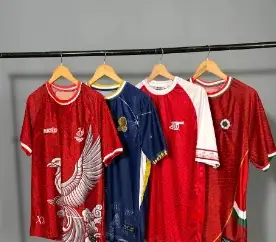
- Full (all-over) sublimation covers the whole garment, seam to seam, including sleeves and collars. It is the normal method for team kits because it allows any pattern, sponsor logos and player names and numbers in one process.
- Spot sublimation prints a logo or graphic on one flat area of a ready-made garment, such as a chest logo on a polo.
When all-over printing is done on garments that are already sewn, small white marks can appear where the fabric folds, such as seams and underarms. Printing the fabric panels before sewing avoids this, which is why we sublimate team kits as cut-and-sew panels.
Which fabrics can be sublimated?
Sublimation dye only bonds with polyester, so fabric choice decides how bright the result will be.
| Polyester content | Typical result |
|---|---|
| 100% | Full, bright colour. The standard for team jerseys. |
| 80–99% | Near-full colour with very little loss. |
| 65–79% | Visibly paler, faded “vintage” look. |
| Below 65% | Too faded for bright team colours. Choose another method. |
Source: Printable Press: polyester percentage for sublimation. Cotton cannot be sublimated, so cotton tees and hoodies are decorated with screen print or embroidery instead.
The fabric must also be white or very light. Sublimation dye is transparent, so it adds colour to the fabric but cannot cover it. Any white in your design is simply unprinted white fabric.
Common sublimation fabrics for sportswear
- Interlock polyester: smooth and soft, used for soccer, cricket and volleyball jerseys.
- Mesh and bird-eye mesh: extra airflow for basketball jerseys and training tops.
- Polyester-spandex: stretch for compression wear, cycling jerseys and fitted volleyball kits.
- Heavier knits: for rugby and hockey jerseys that must survive pulling.
Lightweight jerseys usually sit around 120–160 GSM. Our fabric GSM guide lists typical weights by garment.
Sublimation vs other decoration methods
| Method | How it works | Best for | Watch out for |
|---|---|---|---|
| Sublimation | Dye bonded into polyester | Full-design jerseys, many colours, names and numbers | Needs light polyester fabric |
| Screen print | Ink layer on top of the fabric | Simple 1–3 colour logos, cotton tees | Cost rises with each colour; can crack on stretch fabric if poorly cured |
| Heat transfer vinyl | Cut vinyl pressed onto the fabric | Adding names and numbers to stock garments | Edges can lift after many washes |
| Tackle twill | Fabric letters stitched on | Classic baseball, hockey and American football numbers | Heavier and slower to produce |
| Embroidery | Thread stitched into the fabric | Crests and logos on polos, jackets and caps | Not suited to large areas |
Many teams combine methods, for example a sublimated jersey with an embroidered crest. For a sport-by-sport view, see our custom team uniforms guide.
Advantages and limits of sublimated sportswear
Advantages
- No cracking, peeling or fading of the print through normal washing, because there is no surface layer.
- Unlimited colours, gradients, patterns and photos at no extra cost per colour.
- The fabric stays light and breathable, which matters in hot, fast sports.
- Names and numbers can be printed from your roster in the same process.
- Exact reorders, because the design is a digital file.
Limits
- Works only on polyester-rich, light-coloured fabric.
- Colours can look slightly different on fabric than on a screen, so always approve a physical sample.
- A classic raised look, such as stitched baseball numbers, needs tackle twill instead.
Which sports use sublimated kits?
Sublimation is now the standard for most team sports played in lightweight polyester:
- Soccer jerseys and football kits
- Basketball uniforms
- Volleyball uniforms
- Cricket uniforms
- Rugby uniforms
- Lacrosse uniforms and paintball jerseys
How to prepare artwork for sublimation
- Logos in vector format: AI, EPS, PDF or SVG keep edges sharp at any size.
- Images at full print size: photos and textures should be high resolution at the size they will be printed. If you only have a small image, send it anyway and we will check it before the mock-up.
- Colour references: give Pantone codes for team colours. Sublimation can match closely, but a printed sample is the final check.
- Roster: a spreadsheet with each player’s name, number and size.
- Size chart: agree one chart for the whole team. Our size charts and tech pack template help here.
How to care for sublimated jerseys
- Wash inside out in cool or warm water with similar colours.
- Skip bleach and fabric softener, which can affect moisture-wicking polyester.
- Hang to dry or use a low dryer setting.
- Avoid ironing directly on the print with high heat.
How ordering works with Pexton Apparel
- Brief: send your design idea, fabric, colours, logos and quantities by size.
- Mock-up and quote: we reply with a free digital mock-up and a quote within 24 hours.
- Sample: a physical sample is ready in about 8–10 days, so you can check colour, fabric and fit.
- Bulk production: 10–12 days after sample approval, depending on quantity.
- Quality check and shipping: every order is checked for print, measurements and stitching before packing. We ship DDP (duties paid) to the USA, UK and most of Europe. See shipping and returns for other countries.
Our minimum order is 30 pieces per design, and you can mix sizes within that quantity, so one squad can order youth and adult sizes together.
What affects the price of sublimated sportswear
- Fabric type and weight
- Garment style: plain jersey, raglan sleeves, collars, side panels
- Number of pieces per set, such as jersey, shorts and socks
- Extras like embroidered crests, woven labels and custom packaging
- Order quantity per design
The number of colours in the design does not change the sublimation price. Our custom clothing price guide explains each cost factor in more detail.
Frequently asked questions
What is sublimated sportswear?
It is sportswear whose design is dyed into polyester fabric with heat, so the print becomes part of the fibre and does not crack or peel.
Does sublimation fade or crack?
The print does not crack or peel because there is no ink layer on the surface. With normal washing it keeps its colour very well.
Can you sublimate on cotton or dark fabric?
No. Sublimation needs polyester-rich fabric in white or a very light colour. Cotton and dark garments are decorated with screen print or embroidery instead.
Do player names and numbers cost extra on sublimated kits?
On our sublimated uniforms, names and numbers are printed from your roster in the same process, with no extra cost per colour.
What is the minimum order for sublimated jerseys?
Pexton Apparel’s minimum order is 30 pieces per design, and sizes can be mixed within that quantity.
How long does a sublimated team order take?
Samples take about 8–10 days and bulk production 10–12 days after sample approval, plus shipping time to your country.
Explore our custom sportswear manufacturing and sportswear range, then send us your design brief.
Ready to design your sublimated team kit?
MOQ from 30 pieces · samples in 8–10 days · DDP shipping to the USA, UK & Europe.
Explore More From Pexton Apparel
Related Guides Custom Team Uniforms Guide Private Label Activewear Guide Fabric GSM Guide Low MOQ Clothing Manufacturing
Product Categories Custom Sportswear Basketball Uniforms Volleyball Uniforms Cricket Uniforms
Manufacturing for Your Market USA Clothing Manufacturer UK Clothing Manufacturer Ireland Clothing Manufacturer Europe Clothing Manufacturer Canada Clothing Manufacturer Australia Clothing Manufacturer New Zealand Clothing Manufacturer